
What if the biggest challenge facing our communities isn’t a lack of talent, funding, or technology, but the fact that our institutions are trying to solve complex problems in isolation?
Across the United States and around the world, we have built remarkable institutions.
Businesses innovate.
Universities educate.
Nonprofits serve.
Governments regulate.
Communities adapt.
Each plays an important role.
Yet despite billions of dollars invested in workforce development, education, economic development, and community programs, we continue to face many of the same challenges:
- Youth unemployment and underemployment
- Skills gaps despite increasing educational attainment
- Social isolation and declining civic participation
- Difficulty transitioning students from education into meaningful work
- Communities becoming increasingly fragmented
- Businesses struggling to find talent while talented people struggle to find opportunities
The question is no longer whether these institutions are working hard.
The question is whether they are working together.

The Problem Isn’t a Lack of Effort. It’s Fragmentation.
Modern society has become highly specialized.
Education focuses on education.
Business focuses on profit.
Nonprofits focus on social impact.
The government focuses on policy.
Communities are often left trying to connect these pieces themselves.
As a result, we create excellent organizations, but weak ecosystems.
This fragmentation is increasingly recognized as a barrier to workforce development and economic mobility. Education providers, employers, workforce agencies, and community organizations often operate in parallel rather than as an integrated system, making it harder for people to navigate pathways into meaningful work.
Unfortunately, communities do not experience problems in isolated categories.
A young person who cannot find employment may also lack professional networks, practical experience, mentors, transportation, confidence, and access to local opportunities.
Those challenges cannot be solved by education alone.
Nor by business alone.
Nor by the government alone.
They require an ecosystem.
The False Separation Between Business and Society
For decades, many organizations have viewed corporate success and community well-being as separate objectives.
One asks,
“How do we grow the business?”
The other asks,
“How do we improve society?”
But what if those were actually the same question?
A thriving business depends upon:
- educated people
- healthy communities
- trust
- skilled workers
- entrepreneurship
- strong local economies
Likewise, thriving communities need:
- sustainable businesses
- meaningful employment
- innovation
- investment
- leadership
Neither can flourish for long without the other.
The companies creating the greatest long-term value increasingly recognize that investing in employees, education, and communities strengthens both social impact and business resilience.
Rethinking the Purpose of the Modern Company
Imagine if technology companies saw themselves not only as creators of products but as builders of human capacity.
Imagine if engineering companies became places where university students could learn alongside professionals before graduation.
Imagine if healthcare organizations became continuous learning hubs for future nurses, technologists, and community health workers.
Imagine if manufacturers regularly partnered with local schools, universities, and neighborhoods to solve real problems while developing future talent.
Instead of viewing education as someone else’s responsibility, businesses would become active participants in developing the people and communities that sustain them.
The result is not charity.
It is ecosystem building.
Education Should Extend Beyond the Classroom
Universities produce extraordinary ideas.
Every semester, students design prototypes, conduct research, and solve complex technical problems.
Yet many of these projects end when the semester ends.
The knowledge remains inside the institution.
Communities often never benefit.
Businesses rarely discover the innovation.
Students graduate with grades but without demonstrated community impact.
What if every student project had a pathway into the real world?
What if businesses became pilot partners?
What if nonprofits became implementation partners?
What if local communities became co-creators rather than passive recipients?
Education would no longer be preparation for life.
It would become part of life itself.
Communities Are Not Consumers. They Are Co-Creators.
Too often, communities are viewed only through the lens of need.
Communities need jobs.
Communities need investment.
Communities need services.
But communities also possess extraordinary assets.
Skills.
Relationships.
Experience.
Local knowledge.
Entrepreneurship.
Creativity.
The challenge is that these assets often remain invisible.
The opportunity is to make them visible—and connect them.

The Choicest Fruit Vision
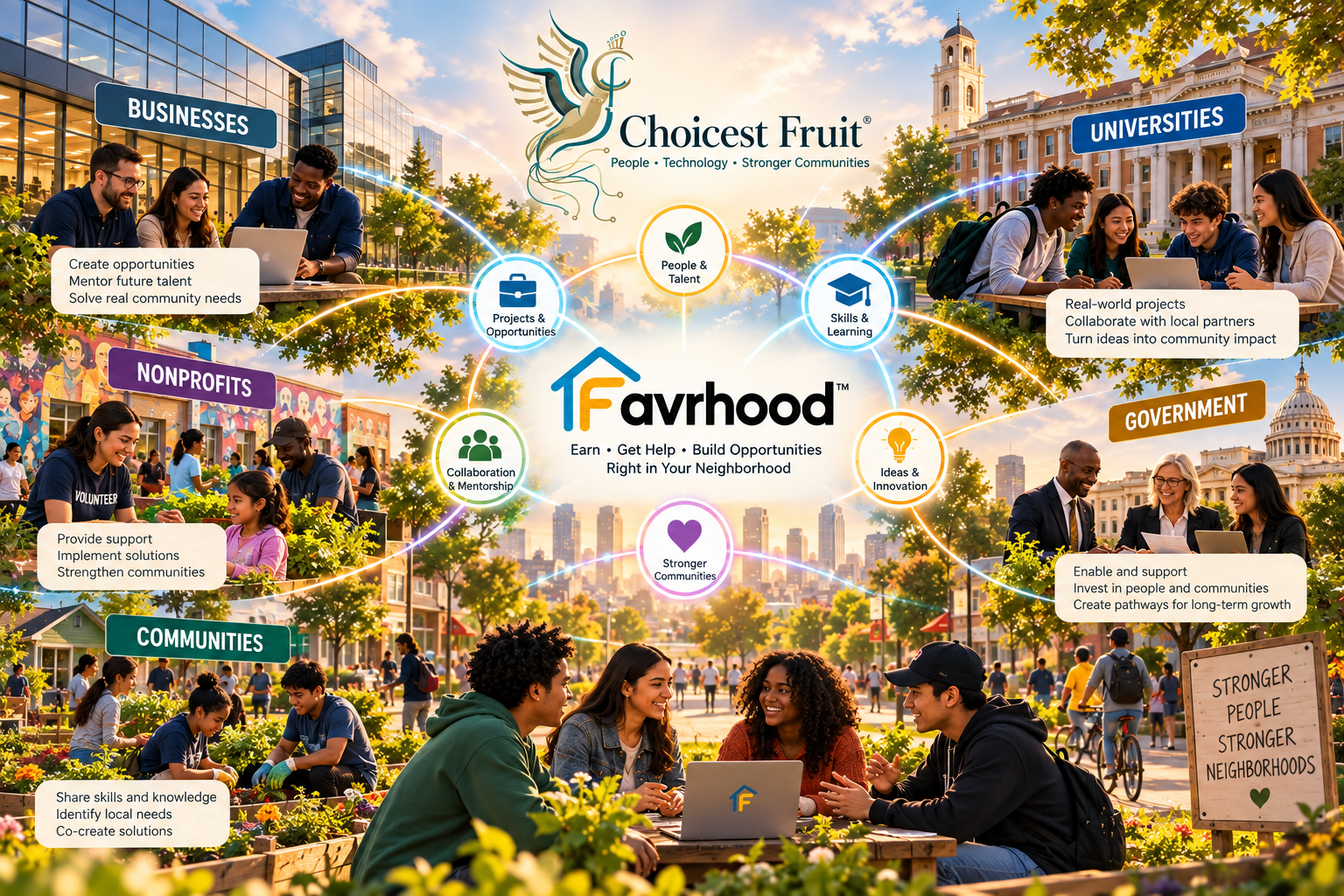
At Choicest Fruit, we believe the future belongs to ecosystems rather than isolated institutions.
Our vision is not simply to build software.
It is to help build communities where education, business, and community life reinforce one another.
Where:
- companies contribute to developing future talent
- universities collaborate with local businesses and organizations
- students solve real community challenges
- nonprofits become innovation partners
- local residents actively contribute their skills and knowledge
- technology strengthens human relationships rather than replacing them
This is why we created Favrhood.
Favrhood is not simply a marketplace or another social platform.
It is a digital infrastructure for local collaboration.
A place where students, professionals, businesses, nonprofits, educators, and neighbors can discover one another, contribute their talents, build trust, create opportunities, and solve problems together.
Instead of asking,
“Who can help me?”
Favrhood encourages communities to ask,
“What can we build together?”
A New Measure of Success
Traditionally we measure success by:
- GDP
- revenue
- graduation rates
- employment numbers
These are important.
But they tell only part of the story.
What if we also measured:
- How connected is our community?
- How many students gained real-world experience before graduation?
- How many businesses mentored future professionals?
- How many community problems were solved collaboratively?
- How many local partnerships emerged?
- How many people discovered opportunities because someone nearby knew their skills?
These are indicators not only of economic growth but of community capacity.
Moving From Fragmentation to Flourishing
Many of today’s greatest challenges are not isolated problems.
They are interconnected systems problems.
Unemployment is connected to education.
Education is connected to the community.
Community is connected to business.
Business is connected to long-term prosperity.
If we continue addressing each challenge separately, we should not be surprised when progress remains slow.
The future requires a different mindset.
Not businesses or communities.
Not education or employment.
Not profit or purpose.
But ecosystems where each strengthens the other.
At Choicest Fruit, we believe that when people, organizations, and communities begin learning and building together, opportunity becomes local, innovation becomes inclusive, and prosperity becomes something that is created, not merely distributed.
The future will not belong to the most isolated institution.
It will belong to the strongest ecosystem.


